 Türkçe
 English

Blog
Bursa Full Mouth Implant
Full Mouth Implant Treatment in Bursa: A Permanent, Aesthetic, and Strong Solution for Complete Tooth Loss
While the absence of even a single tooth in the mouth negatively affects daily quality of life, losing all teeth (complete tooth loss / edentulism) leaves very deep physical and psychological marks on a person’s life. Not being able to chew the desired foods comfortably while eating, having difficulty pronouncing words while speaking, feeling the need to cover the mouth when smiling, and most importantly, the face gradually collapsing over time and making the person look much older than they are are the most obvious consequences of complete tooth loss.
In the past, the only option for patients who had lost all of their teeth was removable full dentures, commonly known as "dentures," which tried to stay in place by adhering to the palate tissue. However, these dentures slipping from the palate, risking falling out while speaking, causing sores and irritation in the mouth, and providing only 20% of chewing force became a major ordeal for patients. Today, thanks to modern oral surgery and implantology infrastructure, this necessity has been completely eliminated.
With advanced healthcare technologies, 3D tomography infrastructure, and experienced maxillofacial surgeons, full mouth implant treatment in Bursa is a safe treatment center for patients coming from both Turkey and abroad. In this guide, we will examine the scientific details of full mouth implant (full jaw restoration) treatments, the All-on-4 and All-on-6 techniques used, the treatment stages, and all the processes you may be curious about in detail.
What Is Full Mouth Implant Treatment and Who Is It Suitable For?
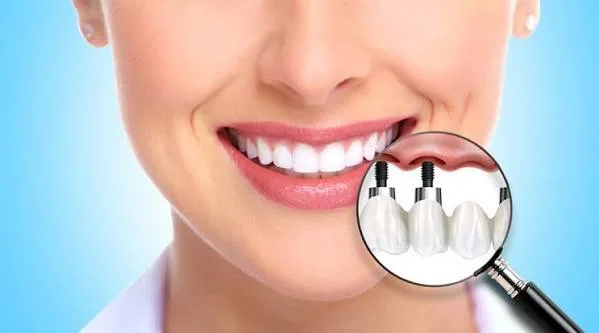
Full mouth implant treatment is the process of integrating fixed or semi-fixed prostheses onto titanium artificial tooth roots (implants) placed at strategic angles into the jawbone for patients who have no teeth left in the upper jaw, lower jaw, or both jaws (or whose remaining teeth must be extracted).
Complete Tooth Loss (Edentulism) and the Biophysiology of Jawbone Resorption
When a tooth is extracted or lost, the jawbone in that area is deprived of functional stimulation (chewing pressure). The body gradually begins to resorb the bone tissue that is not being stimulated. In patients who use removable dentures for many years, the superficial pressure the prosthesis places on the bone further accelerates this resorption. As the bone resorbs, the vertical dimension of the face shortens; the lips collapse inward, the chin moves forward, and a pronounced "aged face profile" appears.
The titanium screws placed in full mouth implant treatments integrate into the jawbone just like natural tooth roots (osseointegration). By transferring mechanical forces generated during chewing to the bone tissue, they trigger bone formation at the cellular level and completely stop jawbone resorption.
Who Is a Suitable Candidate for Full Mouth Implant Surgery?
Almost anyone whose jawbone development is complete and whose overall health does not prevent surgical intervention can benefit from this treatment. The general patient profile is as follows:
Completely Edentulous Patients: People who have no teeth in the lower and/or upper jaw.
Those Whose Existing Teeth Cannot Be Saved: Patients whose all teeth in the mouth must be extracted due to advanced periodontal (gum) disease, widespread decay, or mobility.
Those Dissatisfied with the Comfort of Removable Dentures: People who experience irritation, pain, speech problems, or loss of taste while using dentures.
Those with Controlled Systemic Diseases: Adults with conditions such as diabetes or hypertension whose values are kept stable with medication.
Modern Surgical Techniques Used in Full Mouth Implant Treatment
In cases of complete tooth loss in both jaws, placing an implant for each tooth individually is neither anatomically nor economically a necessary or appropriate approach. Considering the biomechanical structure of the jawbone, a certain number of implants are placed in the strongest areas of the bone, and bridge prostheses covering the entire jaw are designed on top of them.
All-on-4 and All-on-6 Concepts
Bursa full mouth implant procedures most commonly use two core concepts whose clinical success has been proven by academic studies worldwide:
All-on-4 Technique: It was developed especially for patients with severe bone loss in the posterior jaw areas and those who do not want advanced bone grafting (bone powder) / sinus lifting surgery. Two straight implants are placed in the front part of the jaw, and two tilted implants are placed in the back part at 30-45 degree angles so as not to damage the sinus cavities and nerve canals. A fixed prosthesis containing 10-12 teeth is screwed onto a total of 4 implants.
All-on-6 Technique: It is preferred in patients whose jawbone height and width are sufficient. By placing 6 implants in the jaw, chewing forces are distributed more evenly across the jaw. It is generally restored with full-arch zirconium or porcelain bridges containing 12-14 teeth.
Comparison of Traditional Dentures and Implant-Supported Full Arch Prostheses
In the table below, you can review the main differences between traditional dentures and full mouth implant systems:
Comparison Feature | Traditional Removable Denture (Dentures) | All-on-4 / All-on-6 Implant Treatment |
Stability and Retention | It adheres to the palate tissue by suction and may slip. | It is screwed into the jawbone, is 100% fixed, and definitely does not move. |
Chewing Capacity | Provides 20 - 30% of natural chewing force. | Restores 90 - 95% of natural tooth chewing force. |
Palate Coverage | Fully covers the upper palate, reducing taste perception. | Leaves the palate completely open, with natural taste and temperature sensation. |
Effect on Bone Resorption | It cannot prevent bone resorption; on the contrary, it may accelerate it. | It stimulates the jawbone, stopping resorption and preserving it. |
Comfort of Use | Must be removed and cleaned at night, adhesive may be needed. | It is brushed like your own natural teeth and is not removed at night. |
Important Information: In very advanced cases with excessive bone resorption in the upper jaw where standard implants cannot be placed, full-mouth fixed dental restorations can also be successfully performed thanks to Zygoma implants anchored in the cheekbone.
Full Mouth Implant Treatment Stages and Recovery Process in Bursa
Full mouth implant treatment is a multidisciplinary surgical and prosthetic process that requires high precision. In modern clinics in Bursa, this procedure is carried out with digital dentistry protocols.
1. Digital Diagnosis, 3D Tomography, and Surgical Guide
The first step of the treatment is scanning every millimeter of the jawbone with 3D Dental Volumetric Tomography (CBCT). With special software on the computer, the density of the jawbone and the locations of the nerve canals and sinuses are determined.
Before surgery, the doctor simulates on the computer screen the angles at which the implants will be placed. If needed, thanks to "Surgical Guide Plates" (Guide) produced by 3D printers, the implants are placed into the bone with millimetric precision during surgery without opening a gum flap (flapless surgery).
2. Surgical Procedure and Same-Day Temporary Teeth (Immediate Loading)
The surgical procedure is performed under local anesthesia. For patients with phobias or those who become overly anxious, sedation or general anesthesia options are applied. During the operation, the patient does not feel any pain whatsoever.
Same-Day Smile (Immediate Temporization): One of the biggest advantages of All-on-4 or All-on-6 techniques is that fixed temporary prostheses are placed for the patient on the same day as the surgical procedure (or within the first 24-48 hours). The patient never leaves the clinic without teeth; they continue their social and work life without interruption.
3. Waiting Period (Osseointegration) and Permanent Prosthesis
During the 3 to 4 month healing period spent with temporary teeth, the titanium screws are expected to biologically fuse with the jawbone. After this period, digital intraoral scanners are used to take measurements and production of the permanent prostheses begins.
For permanent prostheses, porcelain with zirconium substructure or Pekton/Titanium hybrid systems are generally preferred for aesthetics and durability. The permanent teeth are screwed onto the implants after an aesthetic smile design (Hollywood Smile) suitable for the person’s facial anatomy, skin tone, and age group is created.
In Conclusion; Complete tooth loss is a serious condition that lowers quality of life, undermines self-confidence, and threatens health. However, full mouth implant treatment in Bursa; with contemporary methods such as All-on-4, All-on-6, and digitally guided surgery, solves this problem in a lifelong, aesthetic, and strong way. Getting rid of the limitations of removable dentures and regaining the comfort and aesthetics of your own natural teeth is completely possible with today’s technology.