 Türkçe
 English

Blog
Bursa Zygoma Implant
Bursa Zygoma Implant: Advanced Surgical Solutions for Upper Jaw Bone Loss
For a healthy chewing system and an aesthetic facial profile, the volume and density of the upper jawbone (maxilla) are critically important. However, tooth loss at an early age, long-term use of removable (palatal) dentures, severe periodontal (gum) infections, or trauma can lead to significant bone loss (resorption) in the upper jaw. In traditional dentistry, placing standard dental implants in patients with such extensive bone loss is anatomically impossible.
In the past, the only option for these patients was major surgical operations in which large bone blocks taken from the hip or shinbone (autograft) were transferred to the jaw. In current medical and maxillofacial surgery practice, however, Bursa zygoma implant treatments, which are directly supported by the cheekbone (zygomatic bone) without the need for bone powder or grafting procedures, have become the most reliable medical solution in cases of complete edentulism and advanced bone loss. In this comprehensive clinical guide, we will examine the anatomical working principles of zygomatic implants, the surgical process, and the functional advantages this procedure, which requires advanced maxillofacial surgery, offers patients in the light of scientific data.
What Is a Zygomatic Implant (Cheekbone Implant)?
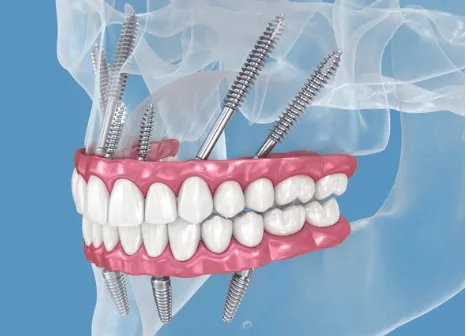
Zygomatic implants are titanium screw systems that take their name from the "Os Zygomaticum," or cheekbone, where they are anchored, and are much longer than standard dental implants (typically ranging from 35 mm to 55 mm) and designed with special angles.
Under normal conditions, dental implants are placed directly into the jawbone. However, the upper jawbone has a porous structure almost like a sponge and begins to resorb rapidly when teeth are lost. In contrast, the cheekbone is one of the hardest, densest (cortical) bones in the human skull and does not undergo age-related resorption. The basic scientific principle behind Bursa zygoma implant applications is to bypass the weak or insufficient bone in the upper jaw and anchor the titanium screws directly into this extremely strong and stable cheekbone.
In Which Clinical Conditions Is a Zygomatic Implant Indicated?
For a zygomatic implant to be considered for a patient, standard implant procedures must be medically impossible to perform. The maxillofacial surgeons at Bursa zygoma implant clinics usually apply this treatment to the following specific patient groups:
Advanced Maxillary Atrophy: Cases in which the upper jawbone has become so paper-thin that it cannot even accept standard implants or bone powder (sinus lifting) procedures.
Failed Graft Operations: Patients whose jawbone was previously augmented with bone powder (graft), but this bone grafting failed due to infection or tissue rejection.
After Tumor or Cyst Surgery: Individuals in whom a portion of the jawbone (maxillectomy) was surgically removed due to cystic lesions or benign/malignant tumors in the upper jaw.
Syndromic Cases: Patients with congenital tooth absence or insufficient jawbone development (for example, ectodermal dysplasia).
Medical Comparison Between Standard Implants and Zygoma Implants
For a patient with advanced bone loss, understanding the differences between traditional bone grafting (advanced grafting) and zygomatic surgery directly affects treatment choice.
Comparison Criterion | Advanced Bone Grafting (Iliac Graft / Autogenous Block) | Bursa Zygoma Implant Surgery |
Treatment Duration | After the bone graft, 6-9 months are waited for the implant and an additional 3 months for tooth placement (Total 9-12 months). | Usually, implants are placed the same day or within 48 hours and fixed temporary teeth are attached. |
Number of Surgical Areas | There are two separate surgical sites (e.g., bone is taken from the hip and grafted into the jaw). It creates additional morbidity. | There is a single surgical site (intraoral only). No tissue is taken from outside or another part of the body. |
Success and Integration Rate | There is a risk of the grafted bone resorbing, becoming infected, or failing to heal. | Because the cheekbone is very hard (cortical bone), the implant's initial fixation (primary stability) resistance is above %98. |
Use and Loading | During the months-long bone healing process, the patient must use dentures or remain toothless. | The implants provide biomechanical resistance suitable for immediate loading as soon as they are placed. |
Bursa Zygoma Implant Treatment Process and Clinical Stages
Zygomatic implant surgery is a major operation that goes far beyond general dental practice and requires advanced anatomy, knowledge of neighboring ear-nose-throat (ENT) structures, and maxillofacial surgical experience. Patients undergoing the Bursa zygoma implant process go through the following standardized clinical protocols:
1. 3D Radiographic Diagnosis and Virtual Planning
Two-dimensional X-rays have no medical value in such complex surgeries. A 3D Dental Volumetric Tomography (CBCT) scan is обязательно taken from the patient. The maxillofacial surgeon measures the volume of the cheekbone, the size of the sinus cavities, and the distance to the orbital floor with millimetric precision using computer software. Before the surgery even begins, the angles at which the implants will be placed are virtually determined on the computer. This planning is vital to eliminate the margin of error during surgery.
2. Anesthesia Protocol and Surgical Procedure
Considering the size of the operation and the patient's comfort, zygoma surgery is usually performed in a fully equipped operating room under "General Anesthesia" or deep "Conscious Sedation," under the supervision of an Anesthesiology and Reanimation Specialist.
After the patient is completely anesthetized, the maxillofacial surgeon reaches the cheekbones from inside the mouth (without any incision or scar on the face). Depending on the anatomy, one or two zygomatic implants are usually placed in the right and left cheekbones (Quad Zygoma concept). If there is some bone remaining in the anterior jaw, 2 to 4 standard implants are also placed in this area to strengthen biomechanical support.
3. Rapid Fixed Prosthesis Loading (Immediate Loading)
The cheekbone is structurally so hard that the placed implants immediately reach a very high torque (retention force) value. Thanks to this strong fixation (primary stability), in Bursa zygoma implant clinics the patient's pre-prepared fixed temporary teeth are screwed onto the implants on the day the surgery ends or within 48 hours at the latest. The patient emerges from years of toothlessness with fixed teeth on the day they wake up from surgery.
Post-Operative Care and Recovery
Although it is an advanced surgical operation, the healing process is quite predictable when tissue-respecting and evidence-based surgical principles are applied.
Edema and Bruising: Since the cheekbone area is close to the eye region, swelling (edema) and mild bruising in the cheeks and under the eyes during the first 3-4 days after surgery is an expected physiological condition. Cold compresses applied to the area and the corticosteroid/antibiotic medications prescribed by the doctor quickly bring this under control.
Diet Discipline: Although temporary fixed teeth are attached, the fusion of the implants with the cheekbone at the cellular level (osseointegration) takes 4-6 months. During this process, a "soft diet" (pasta, fish, boiled vegetables, foods in puree form) must be followed in order not to place excessive load on the implants.
Oral Hygiene: To prevent infection in the surgical area, it is critically important to clean the sutured areas and the undersides of the temporary teeth with special mouth rinses and surgical brushes.
Why Should Specialist Maxillofacial Surgery Clinics Be Preferred for Zygoma Surgery?
Zygomatic implant surgery is not a routine tooth extraction or standard implant procedure. As the titanium screws are placed, they pass through or immediately beside the anatomical space called the maxillary sinus; the area where the procedure is performed is adjacent to the eye socket (orbit) and important neurovascular networks.
Therefore, when planning a Bursa zygoma implant, it is a medical necessity that the physician you consult has completed postgraduate specialty training in "Oral, Dental and Maxillofacial Surgery" after dental school and is a surgeon knowledgeable in maxillofacial trauma and skull base anatomy. Well-equipped clinics not only perform the procedure but also carry out preoperative ENT (Ear, Nose and Throat) consultations and have the scientific competence to manage medical conditions that may arise after surgery.
Conclusion: Toothlessness Is Not Fate, and It Is Not Hopelessness
For patients who have been told for years that "your jawbone has completely resorbed, implants can no longer be placed," and who are tired of the sores caused by removable dentures, the fear of them falling out while speaking, and the problem of being unable to chew, the Bursa zygoma implant treatment is the medical key to reconnecting with life.
Without the need for major bone surgery, months of waiting without teeth, or taking bone from another part of the body, this advanced surgical protocol that directly uses the strength of the cheekbone can help you regain fixed, aesthetic, and strong teeth. To obtain the clearest scientific data about the condition of your own jawbone and your suitability for zygomatic surgery, do not delay making an appointment for a radiographic examination with a specialist maxillofacial surgeon.
Legal Warning and Information
This content has been prepared solely for the purpose of medically informing the public about oral and maxillofacial surgery and advanced implantology practices, in compliance with the Law No. 1219 on the Practice of the Art of Medicine and its Branches and the Regulation on Promotional and Informational Activities in Healthcare Services. The information in the content cannot be used for the diagnosis/treatment of diseases or anatomical deficiencies; it does not contain any guaranteed success or medical assurance for any patient. To determine the volume of your jawbone and your suitability for surgical operations clinically and radiologically, you must apply to a specialist in Oral, Dental and Maxillofacial Surgery and undergo an in-person examination.
Your Turn! Have you previously received negative feedback from your dentists that implants could not be placed because of bone loss in your upper jaw? How does the idea of zygomatic implants anchored to the cheekbone with a single operation instead of taking bone from another part of the body (grafting) make you feel medically? Or is receiving dental treatment under general anesthesia important for your comfort? Share your clinical experiences, the processes you are curious about, or all your medical questions about Bursa zygoma implant with us in the comments section below, and let our maxillofacial surgery specialists answer them with great care!